OCT retinal scan
A photograph of the back of your eye and a three-dimensional cross-section of the retina, taken in the same sitting. It is quick, painless and nothing touches your eye.
- Topcon 3D OCT
- Non-invasive and painless
- Kept on record and compared at each visit
Your appointment
- Who it is for
- Offered to every patient, alongside the eye examination.
- What happens
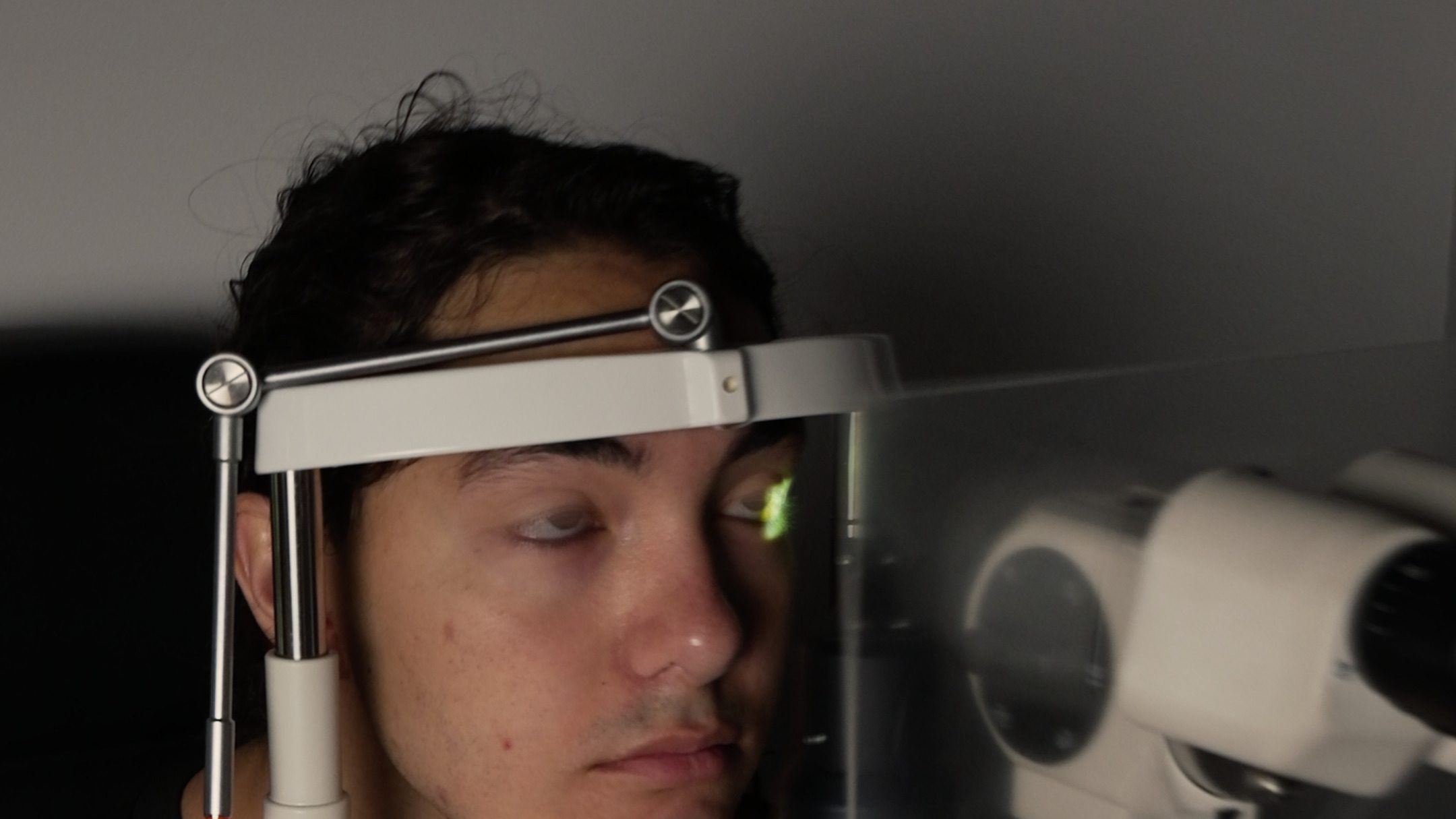
- You rest your chin and look at a target. The scan takes a few seconds for each eye, and nothing touches your eye.
- Afterwards
- We go through the images with you on the screen and keep them on your record, to compare at your next visit.
What it is
OCT stands for optical coherence tomography. It uses light to show the layers of the retina, the light-sensitive tissue at the back of the eye, in far more detail than a photograph alone.
Because each scan joins your record, small changes can be compared from one visit to the next. That comparison is where much of its value lies.
What it can help us see
- Macular degeneration
- Gradual breakdown of the macula, the part of the retina that gives sharp central vision. Most common over the age of fifty. OCT helps tell wet from dry and track any change.
- Glaucoma
- Damage to the optic nerve where it leaves the eye, often with no early warning. The scan adds a check alongside eye pressure and visual field tests.
- Diabetic retinopathy
- Changes to the retina caused by diabetes, a major cause of sight problems in adults. OCT looks through the layers of the retina, not just at its surface.
- Macular hole
- A small break in the macula that can blur or distort central vision. It shows clearly in cross-section.
- Vitreous traction
- With age the gel inside the eye separates from the retina. Where it does not let go cleanly it can pull on the surface, which OCT shows plainly.
What happens next
We go through the images with you on the screen. If we see something that needs attention we explain what it is and, where appropriate, refer you promptly.
Questions people ask
Is it part of my eye examination?
We offer it to every patient. Ask when you book and we will explain what it involves and what it costs.
Do I need one if my sight seems fine?
Some eye conditions give no warning in their early stages. A scan gives us a baseline to compare against in future, which is useful at any age.
Book an appointment
Tell us what you need and when suits you. We confirm by email or telephone.
Monday to Saturday, 10.30am to 4pm. Other times are available by appointment.