OCT retinal scan
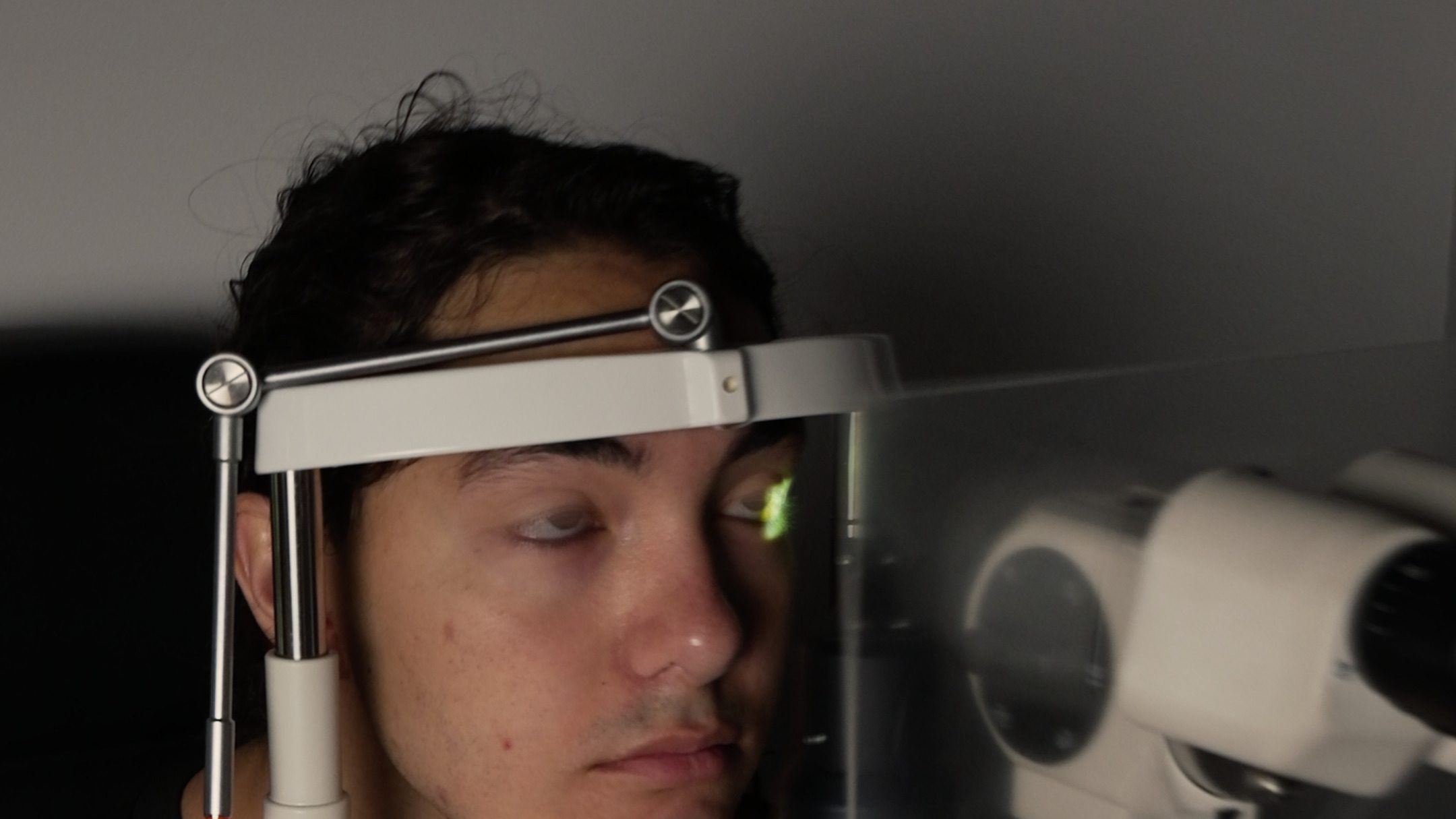
A photograph of the back of your eye and a three-dimensional cross-section of the retina, taken in the same sitting. It is quick, painless and nothing touches your eye.
- Topcon 3D OCT
- Non-invasive and painless
- Kept on record and compared at each visit
What it is
OCT stands for optical coherence tomography. It uses light to show the layers of the retina, the light-sensitive tissue at the back of the eye, in far more detail than a photograph alone.
Because each scan joins your record, small changes can be compared from one visit to the next. That comparison is where much of its value lies.
The eye, in section
Six parts of the eye that an examination looks at, drawn as a cross-section, and the one the OCT scan photographs.
Cornea
The clear window at the front.
Iris and pupil
The ring that sets how much light comes in.
Lens
Focuses near and far.
Vitreous
The clear gel that fills the eye.
Retina
What the OCT scan photographs, layer by layer.
Macula and optic nerve
Fine detail, and the picture to the brain.
What happens next
We go through the images with you on the screen. If we see something that needs attention we explain what it is and, where appropriate, refer you promptly.
What it can help us see
- Macular degeneration
- Gradual breakdown of the macula, the part of the retina that gives sharp central vision. Most common over the age of fifty. OCT helps tell wet from dry and track any change.
- Glaucoma
- Damage to the optic nerve where it leaves the eye, often with no early warning. The scan adds a check alongside eye pressure and visual field tests.
- Diabetic retinopathy
- Changes to the retina caused by diabetes, a major cause of sight problems in adults. OCT looks through the layers of the retina, not just at its surface.
- Macular hole
- A small break in the macula that can blur or distort central vision. It shows clearly in cross-section.
- Vitreous traction
- With age the gel inside the eye separates from the retina. Where it does not let go cleanly it can pull on the surface, which OCT shows plainly.
Questions people ask
Is it part of my eye examination?
We offer it to every patient. Ask when you book and we will explain what it involves and what it costs.
Do I need one if my sight seems fine?
Some eye conditions give no warning in their early stages. A scan gives us a baseline to compare against in future, which is useful at any age.
Book an eye examination
Choose a day and a time online, or call us and we will find one together.